
How to Optimise Your LinkedIn Profile for B2B Businesses (Without Looking Like You're Trying Too Hard)
Your LinkedIn Profile Is a Corporate Dating Profile. Would You Swipe Right on Yourself?
Nobody wants to admit their LinkedIn profile is a disaster. But most people's is.
Not because they don't care about their professional reputation. But because the profile has been quietly sitting there, doing its job badly, while they got on with actually running their business.
If you're wondering how to optimise your LinkedIn profile for a B2B business, most of the advice online assumes you're trying to generate leads.
That's fine if you're cold messaging strangers all day.
But for many service businesses, especially those in logistics, industrial services, consulting and professional services, LinkedIn serves a different purpose.
Most of your prospects already know your name before they find your profile.
They're not deciding whether to talk to you.
They're checking whether you match the reputation that got you referred in the first place.
That's why your LinkedIn profile isn't really a lead generation tool.
It's a credibility check.
The filthy sandpit confession
I'll go first.
Before I updated my profile recently, my headline told the world that LinkedIn was one of my playgrounds and that I loved burritos. My banner image was a holdover from a previous role. My About section was five years old.
Here's the thing about that playground line. Anyone who knows me will tell you I'd rather finish the job properly so I can actually enjoy my free time. I am not all play. I am very much about the work. And yet my LinkedIn profile, the first thing a referred prospect sees when they look me up, was broadcasting the exact opposite message.
If LinkedIn were a dating app I would not have swiped right on myself. Not even close.
The 100 millesecond problem
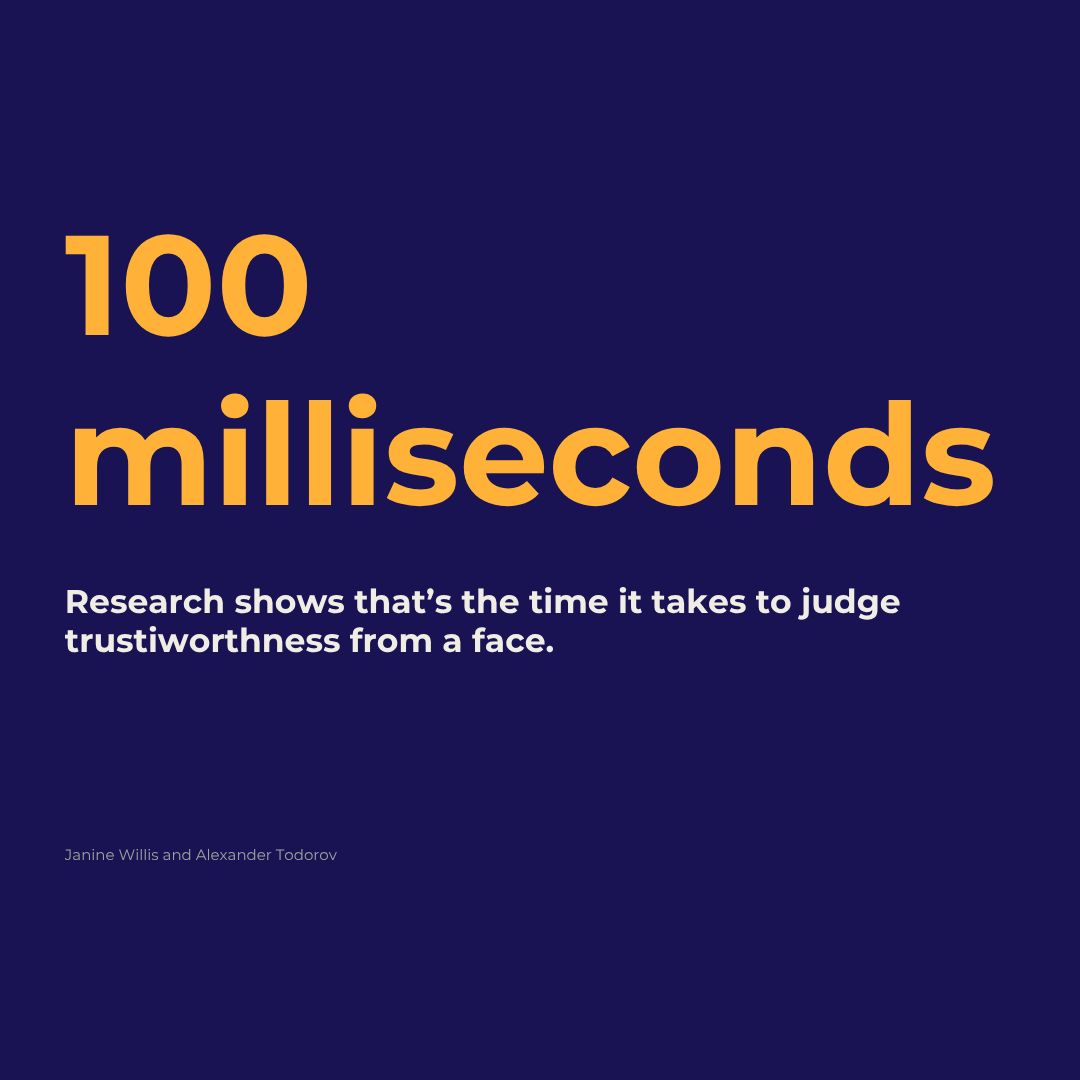
A Princeton study by Janine Willis and Alexander Todorov found it takes just 100 milliseconds for people to judge trustworthiness, competence, and likability from a face. And those snap judgements don't significantly change with more time. The first instinct sticks.
On LinkedIn specifically, your profile photo and headline appear together before anyone ever views your full profile, including search results, connection suggestions, and comment threads. These two elements alone determine whether someone clicks through.
That means the decision about whether you're worth investigating further is being made before anyone has read a word you've written.
How to spot the difference in three seconds
There are two types of LinkedIn profiles. One is built to get leads. One is built to confirm authority. They look completely different and you can tell which is which almost immediately.
The banner image tells you everything. No banner image at all means the person either doesn't understand personal brand or simply doesn't care. A banner with a phone number, email address, or a call to action means they're actively trying to generate leads. A banner with an image that has nothing to do with what they do means they're not quite sure what they want people to know about them. But a banner that communicates a clear value proposition, even without a single contact detail, signals someone who knows exactly what they stand for.
The headline is the next tell. If it starts with 'I help [person] achieve [result] without [pain point]' they are pitching you. If it uses buzzwords, jargon, or frankly anything as misguided as mentioning burritos and playgrounds, they're still figuring it out. But if it states plainly and confidently what they do and who they do it for, without trying to sell you anything, that's an authority profile.
The link under the headline is the final giveaway. If clicking it asks for your email address, takes you to a lead magnet, or offers you something free in exchange for your data, it's a lead generation play. If it simply takes you somewhere that answers your question without extracting anything from you in return, that's someone building authority rather than chasing pipeline.
What a blank or outdated LinkedIn profile says about you
A B2B business owner with a blank LinkedIn profile, or one that hasn't been touched in years, is accidentally broadcasting something they almost certainly don't intend.
It says they're not proud enough of what they do to tell anyone about it. That it's a job rather than a passion. That they haven't thought about how they appear to the people who are quietly evaluating them before every meeting, every partnership conversation, every referral.
The 2024 Edelman and LinkedIn B2B Thought Leadership Study, which surveyed 3,500 global B2B decision-makers, found that 73% of B2B buyers consider thought leadership content to be a more trustworthy basis for judging a company's competencies than traditional marketing materials. And 90% of C-suite executives say they would be more receptive to outreach from a company that consistently produces high quality thought leadership.
Authority isn't claimed. It's demonstrated. And your LinkedIn profile is one of the first places people look to see whether you've bothered to demonstrate it.
The business card analogy
Showing up to a networking event or industry conference without business cards is the physical world equivalent of an empty LinkedIn profile. You're there. You're presumably good at what you do. But you've made it unnecessarily hard for anyone to remember you, find you, or follow up with you.
Nobody says anything in the moment. But they notice.
The one questions worth asking yourself
Before your next referred prospect looks you up, which they will, ask yourself this.
Does my LinkedIn profile reflect the professional I actually am right now? Or does it reflect someone who set it up years ago, got busy, and quietly hoped nobody would look too closely?
Because they are looking. And the first 100 milliseconds matter more than you think.
The 10-minute LinkedIn Audit
Does your headline still describe what you actually do?
Is your banner helping or confusing?
Is your About section less than 2 years old?
Would a preferred prospect immediately understand who you help?
Does your profile look like someone who takes their work seriously?
FAQs
-
At minimum, every time your positioning changes. For most business owners, a six-month review is enough.
-
Yes. Referrals often check LinkedIn before making contact. Your profile helps confirm trust and credibility.
-
What you do, who you help, and enough context that someone understands your expertise in seconds.
Sources
100 milliseconds to judge trustworthiness — Princeton study by Janine Willis and Alexander Todorov https://journals.sagepub.com/doi/10.1111/j.1467-9280.2006.01750.x
73% of B2B buyers trust thought leadership over traditional marketing materials / 90% of C-suite more receptive to outreach from companies producing thought leadership Edelman and LinkedIn 2024 B2B Thought Leadership Impact Report: https://www.edelman.com/expertise/business-marketing/2024-b2b-thought-leadership-report