
It's Not What You Know. It's Who Knows You. (And Now That Includes AI.)
There's a conversation I keep having with B2B business owners who want to be on page one of Google.
It usually starts something like this. A competitor mentioned in passing that they spend ten to fifteen minutes a day on their SEO. Now they want the same thing. They want to outrank the competition. They want to be top dog.
And every time I have this conversation, I think the same thing before I've even looked at their website.
This business is not focused on its customers. It's focused on its competitors.
Those are two fundamentally different orientations. And they produce two fundamentally different businesses.
The page one obsession is solving the wrong problem
B2B service businesses that run on referrals and relationships don't win work because a prospect Googled them. They win work because someone they trust picked up the phone and said go and speak to this person.
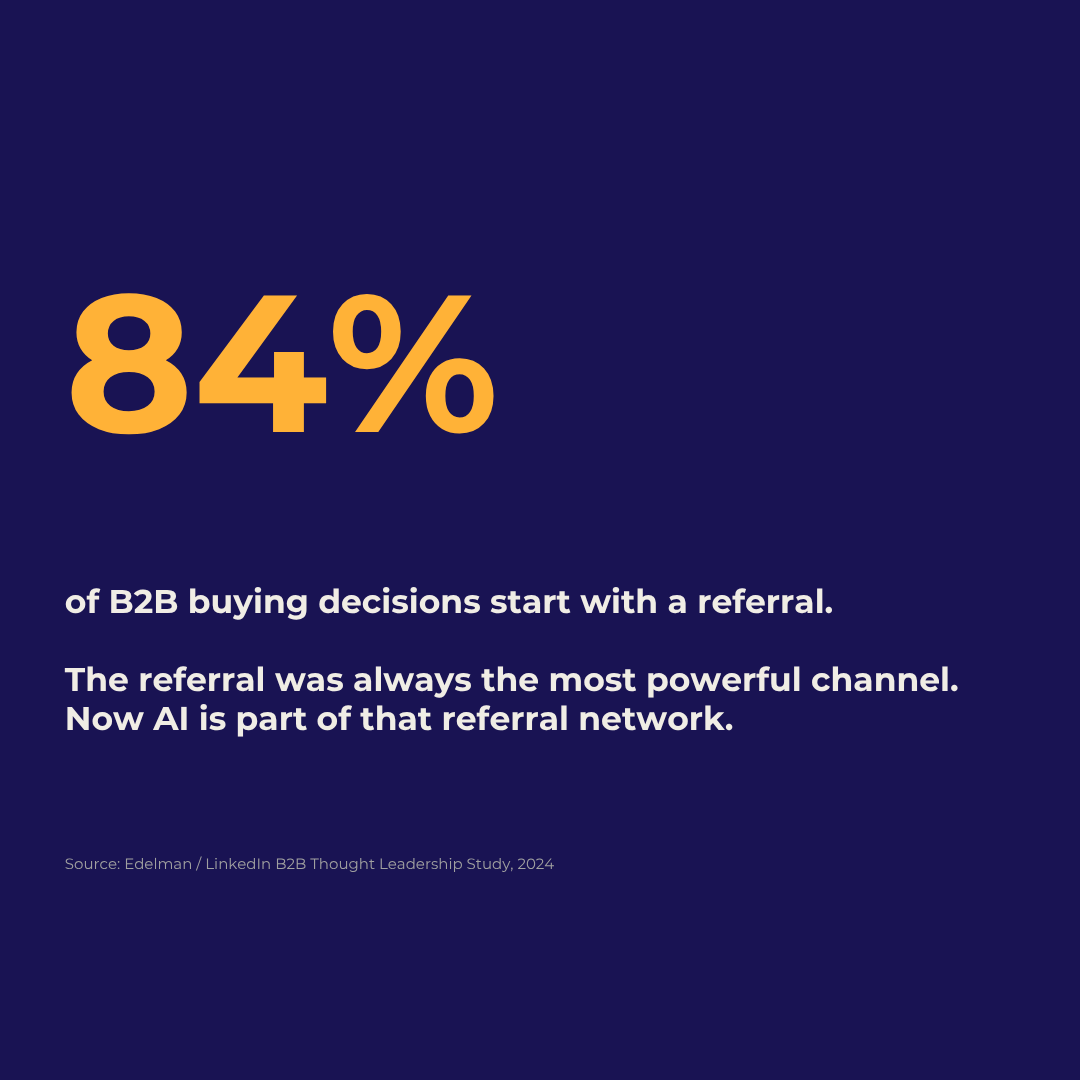
84% of B2B decision-makers say their buying process starts with a referral. 82% of B2B sales leaders believe referrals generate the best leads. Word of mouth affects 20% to 50% of all purchasing decisions.
91% of B2B purchasers' buying decisions are influenced by word of mouth. 61% of IT buyers say recommendations from colleagues are the most important factor that sways their decision.
In highly specialised B2B industries, the procurement conversation is almost never starting with a Google search. It's starting with someone asking their former colleagues and connections who they'd recommend. Sometimes publicly, right there on LinkedIn.
And then Google changed everything. Again.
At Google I/O on 19 May 2026, Sundar Pichai announced that AI Mode has surpassed 1 billion monthly active users in just 12 months, with AI Overviews reaching 2.5 billion monthly active users. Google described the redesigned search box as its biggest upgrade in over 25 years.
Rather than shutting down traditional search, Google is absorbing it inside AI Mode piece by piece, collapsing the distinction between conversational search and traditional results into a single experience.
Reaching position one on Google now earns less than half the traffic that same ranking would have generated in 2024. AI Overviews now trigger on 48% of all tracked search queries, a 58% increase year over year.
What this means in plain English is that the goal has shifted. You no longer need to be on page one of Google. You need to be recommended by an AI engine.
And here's the thing. That's not actually a new problem. It's the same problem it's always been. It's not what you know. It's who knows you.
Except now the who includes artificial intelligence.
-
AI Search Optimisation (sometimes called Generative Engine Optimisation or GEO) is the process of creating content that AI systems like ChatGPT, Google AI Mode, Gemini, Perplexity, and AI Overviews are likely to cite, recommend, and reference when answering questions.
Traditional SEO focused on rankings. AI Search Optimisation focuses on authority, trust, expertise, and citations.
In practical terms, that means creating content that demonstrates genuine experience, answers real customer questions, and earns recognition from both people and platforms.
The businesses most likely to appear in AI-generated answers aren't necessarily the ones ranking number one. They're the ones consistently proving they know what they're talking about.
-
Generative Engine Optimisation (GEO) is the next evolution of search visibility.
Instead of optimising content solely for Google's traditional ranking factors, GEO focuses on helping AI engines understand, trust, and cite your expertise.
If SEO was about helping search engines find your content, GEO is about helping AI engines recommend it.
And despite the new acronym, the underlying principle isn't new at all. Businesses that are genuinely useful, visible, and trusted have always had an advantage. AI is simply changing how that trust gets measured and surfaced.
-
AI engines don't think like traditional search engines.
They're not simply looking for the page with the most backlinks or the highest domain authority. They're trying to identify the most helpful answer.
That means they increasingly favour content that demonstrates:
First-hand experience
Clear expertise
Independent validation
Genuine discussion
Detailed explanations
Customer reviews
Consistent authority signals across multiple platforms
The reason platforms like Reddit, LinkedIn, YouTube, and review sites appear so frequently in AI citations is because they contain real-world conversations and evidence of expertise.
In other words, AI isn't looking for who claims to be the expert. It's looking for proof.
Where AI is actually getting its information
This is the part that should genuinely stop you in your tracks. Because once you understand where AI engines are sourcing their answers, the whole argument about what to focus on instead becomes obvious.
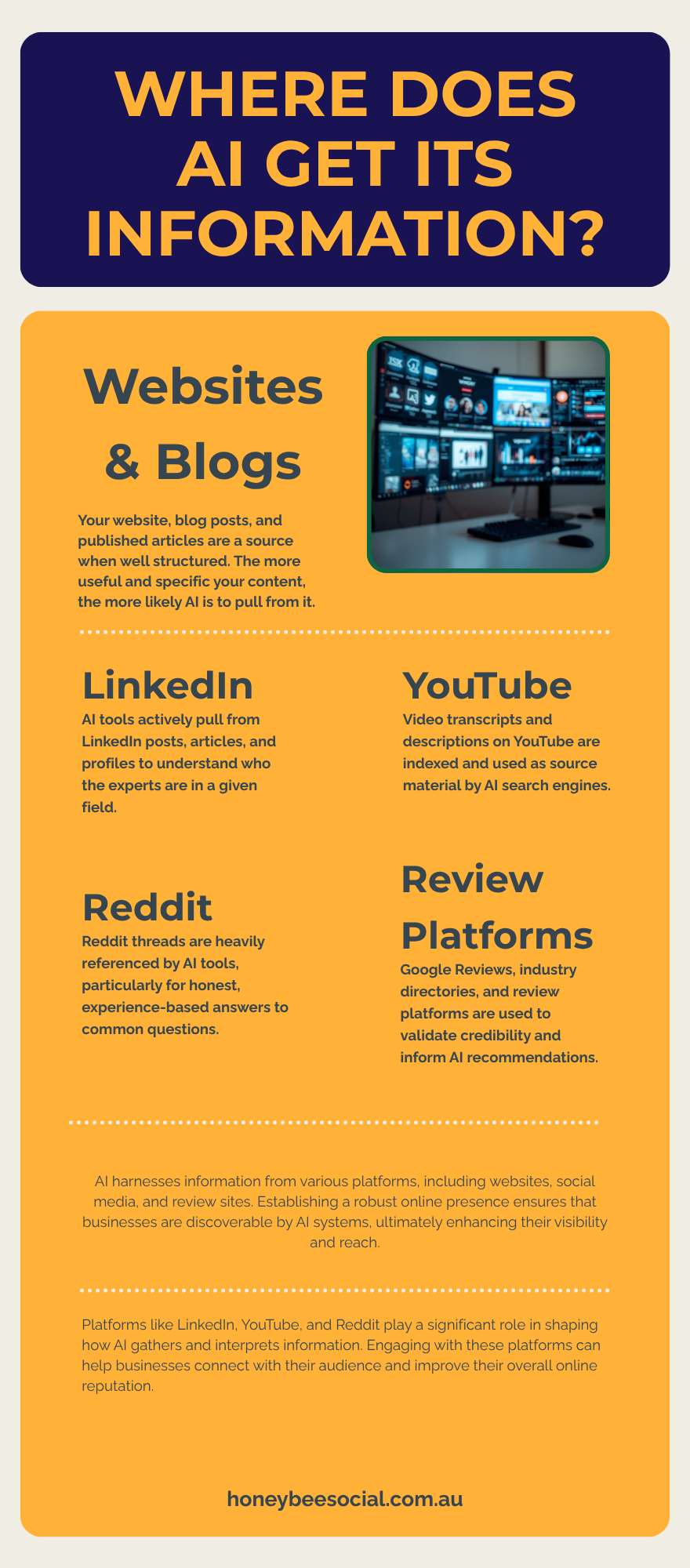
Research tracking citations across ChatGPT, Google AI Mode, Gemini, Perplexity, and AI Overviews found that Reddit was the most cited source across every major AI engine. YouTube, LinkedIn, Wikipedia, and Forbes also ranked in the top five. Review platforms appeared frequently in recommendation queries.
Based on analysis of over 36 million AI Overviews and 46 million citations, Wikipedia, YouTube, Google's own properties, Reddit, and Amazon collectively account for 38% of all citations.
LinkedIn climbed from approximately number 11 on ChatGPT in November 2025 to number 5 by February 2026, the largest authority shift observed all year. LinkedIn newsletters are currently a particularly strong source for Perplexity and Gemini citations.
The reason Reddit dominates is structural. AI engines treat Reddit threads as authentic, experience-based content with community-validated answers. The signal isn't link authority. It's discussion depth.
Brands with profiles on review platforms have three times higher citation chances across AI engines.
Now notice what is conspicuously absent from that list.
Generic company websites optimised for broad keywords. Brochure-ware copy that starts with 'we are the leading provider of'. Blog posts written to rank rather than to genuinely answer a question.
What IS being cited is authentic peer discussion, genuine expertise shared on LinkedIn, video content answering specific questions, honest client reviews, and content that reads like a human actually wrote it for another human who had a real problem.
That is precisely the opposite of what most B2B companies have been told to produce for the last decade.
What this opens up for niche B2B Businesses
People can now type their problem into Google verbatim. Not a carefully constructed search query. Their actual problem, in their own words, exactly as they'd describe it to a colleague.
More than 60% of AI Overview citations now come from outside the first page of traditional search results. Traditional organic ranking is becoming a weaker predictor of AI citation, not a stronger one.
But here's the counter-intuitive finding. Brands cited within AI Overviews earn 35% more clicks than non-cited competitors. And AI-referred visitors convert at significantly higher rates than traditional organic search visitors, because they've already had their basic questions answered and are arriving with higher intent and clearer needs.
The businesses that get cited are the ones answering niche, specific, technically detailed questions in their content. Not optimising for broad keywords. Answering the actual questions their customers ask their sales managers.
“The businesses that get cited are the ones answering niche, specific, technically detailed questions in their content. Not optimising for broad keywords. Answering the actual questions their customers ask their sales managers.”
Think about what your sales team gets asked before a prospect signs anything. For a warehouse racking company it might be "what are the compliance requirements for racking in a facility with robotics?" For a logistics consultancy it might be "what do I need to consider when fitting out a refrigerated warehouse?" For a construction specialist it might be "what's the difference between a DA and a CDC approval for a commercial fit-out?"
Those questions are now being typed verbatim into AI engines. The businesses that have published detailed, honest answers to those exact questions are the ones appearing in the response. Not the ones who spent ten minutes a day on their SEO.
That's the opportunity. And it requires no budget. Just the willingness to share what you already know.
Can Small B2B Businesses Rank In AI Search Results?
Yes. In fact, many smaller specialist businesses are discovering they have an advantage.
Traditional SEO often rewarded scale. Larger businesses could produce more content, build more backlinks, and invest more heavily in optimisation.
AI search is creating opportunities for niche expertise.
A specialist consultant answering a highly specific industry question may have a better chance of being cited than a large company publishing generic content designed to rank for broad keywords.
That's because AI engines increasingly prioritise relevance and expertise over size.
For small B2B businesses, this levels the playing field considerably.
Is Traditional SEO Still Important?
Yes. But its role is changing.
Your website still needs to be technically sound. It still needs clear navigation, strong content, and pages that can be indexed. However, traditional rankings are becoming just one signal among many.
Visibility today is increasingly influenced by:
LinkedIn activity
Reviews
Podcast appearances
Case studies
Industry mentions
Video content
Community discussions
The businesses winning in AI search aren't abandoning SEO. They're just expanding beyond it.
How Do You Get Cited By ChatGPT, Google AI Mode, and Other AI Search Engines?
There's no application form. No magic button.
But the evidence points to several recurring patterns among businesses and experts that appear frequently in AI-generated recommendations.

Five Ways To Increase Your Chances Of Being Cited By AI:
Publish detailed case studies that show real outcomes.
Build a visible thought leadership presence on LinkedIn.
Collect authentic client reviews on relevant platforms.
Appear on industry podcasts and interviews.
Create content that answers highly specific customer questions.
Notice what's missing from that list.
Keyword stuffing.
Because AI engines care far more about credibility than clever optimisation tricks.
What actually moves the needle
When a referred prospect takes a discovery call, they've already been told you know your stuff. Now they need to see it.
Case studies are the most underused and most powerful piece of content a B2B service business can produce. Not glossy marketing documents. Honest accounts of a problem, the solution provided, the process followed, and the outcome achieved. Add a client testimonial and you have the single most persuasive piece of content in your arsenal. And because case studies are substantive, specific, and experience-based, they are exactly the kind of content AI engines are drawn to cite.
Podcast appearances work the same way. Being interviewed on industry podcasts as the expert being asked the questions is a trust building exercise that no keyword ranking can replicate. And transcribed podcast content is increasingly being cited by AI engines for exactly the same reason Reddit is: it reads like a real human answering a real question in a real conversation.
Getting active on LinkedIn with genuine expertise, answering the questions your industry is actually asking, is no longer just good for your human audience. It is now directly feeding the AI engines that your referred prospects are increasingly using to do their research.
Encouraging satisfied clients to leave reviews on relevant platforms matters more than it ever has. Because review platforms are among the most consistently cited sources across every major AI engine.
What Content Gets Quoted By AI Search Engines?
The evidence consistently points towards content that demonstrates expertise through specificity.
This includes:
Detailed case studies
Customer success stories
Technical explainers
Industry commentary
Expert interviews
Podcasts and transcripts
Review content
Question-and-answer content
LinkedIn thought leadership
The common thread is simple. The content is useful because it helps someone solve a real problem. Not because it was written to rank for a keyword.
Key Takeaways
If you're worried about AI search changing the rules, here's the good news. The businesses most likely to succeed aren't necessarily the ones with the biggest SEO budgets.
They're the ones that consistently demonstrate expertise and earn trust.
The key lessons are:
AI search is changing how people discover businesses.
Referrals remain one of the strongest drivers of B2B purchasing decisions.
AI systems increasingly cite LinkedIn, Reddit, reviews, podcasts, and expert content.
Detailed case studies are becoming more valuable than generic blog content.
Thought leadership and genuine expertise are increasingly influencing visibility.
Generative Engine Optimisation (GEO) is about becoming recommendable, not simply rankable.
The goal is no longer just being found. It's being recommended.
Your AI Visibility To-Do List
If you're wondering where to start, focus on these actions first:
This Month
Publish one detailed case study
Ask three happy clients for reviews
Answer five customer questions on LinkedIn
Update your website's About page with clearer expertise and proof points
Repurpose one client success story into a blog post
This Quarter
Appear on at least one podcast
Create a customer FAQ section on your website
Publish content around niche industry questions
Build a library of testimonials and success stories
Create content designed to educate rather than rank
Ongoing
Be visible where your industry has conversations
Share expertise generously
Focus on helping rather than optimising
Build authority before chasing traffic
Create content worth recommending
The orientation that builds a referral-worth business
An authority in any industry is not looking over their shoulder at competitors. They are looking sideways at their customers and forward at the next problem they can help solve.
That orientation is exactly what produces the kind of content that gets shared, gets recommended, and increasingly gets cited by AI.
It's not what you know. It's who knows you.
And now that who includes artificial intelligence. Which, as it turns out, is paying very close attention to whether you've been genuinely useful to your industry or just trying to game a search engine.
FAQs
-
No.
SEO still matters, but rankings are becoming only one part of the visibility equation. Businesses that combine strong SEO foundations with authority-building activities are likely to benefit most. text goes here
-
Create content that demonstrates expertise, directly answers questions, includes evidence, and provides genuine value. AI systems increasingly favour useful content over content written purely for rankings.
-
Potentially, yes.
AI systems frequently reference publicly available information, reviews, expert commentary, case studies, and trusted third-party sources when generating answers.
-
Generative Engine Optimisation is the practice of increasing the likelihood that AI systems cite, recommend, and reference your content when answering user questions.
-
SEO focuses on improving rankings in traditional search results.
GEO focuses on increasing visibility within AI-generated answers and recommendations.
-
No.
The smartest approach is to view SEO as part of a broader visibility strategy that includes thought leadership, reviews, case studies, podcasts, LinkedIn activity, and customer advocacy.
Sources
1. Google I/O 2026 — AI Mode 1 billion users, biggest Search upgrade in 25 years https://www.digitalapplied.com/blog/google-search-overhaul-ai-mode-1b-users
2. BrightEdge — AI Overviews now trigger on 48% of queries, up 58% year on year https://almcorp.com/blog/google-ai-overviews-surge-9-industries/
3. Ahrefs — 58% CTR drop for position one when AI Overview is present https://www.goodfirms.co/resources/seo-statistics-ai-search-rankings-zero-click-trends
4. 60% of AI Overview citations now come from outside page one of Google results https://www.mersel.ai/blog/why-organic-traffic-declining-2026
5. Reddit, YouTube, LinkedIn most cited sources across all major AI engines https://searchengineland.com/ai-search-engines-cite-reddit-youtube-and-linkedin-most-study-473138
6. LinkedIn climbed from #11 to #5 in ChatGPT citations, largest authority shift of the year https://www.averi.ai/blog/linkedin-is-the-1-most-cited-source-in-ai-search-for-professional-queries.-here-s-the-founder-s-playbook.
7. Brands cited in AI Overviews earn 35% more clicks than non-cited competitors https://thedigitalbloom.com/learn/ai-citation-position-revenue-report-2026/
8. 84% of B2B buying decisions start with a referral / 90% of C-suite more receptive to thought leadership outreach Edelman and LinkedIn 2024 B2B Thought Leadership Impact Report https://www.edelman.com/expertise/Business-Marketing/2024-b2b-thought-leadership-report
9. 86% of B2B buyers cite word of mouth from peers as the most influential factor in purchasing decisions (replaces the 91% stat) Blanc and Otus / G2 Crowd research, 800 B2B buyers surveyed https://www.demandgenreport.com/industry-news/study-word-of-mouth-industry-reports-greatly-impact-b2b-buying-decisions/3495/